GardenCity Smiles™ · Yelahanka New Town
Dental Implants in Yelahanka
Replace missing teeth with a plan built around your mouth, comfort and everyday life.
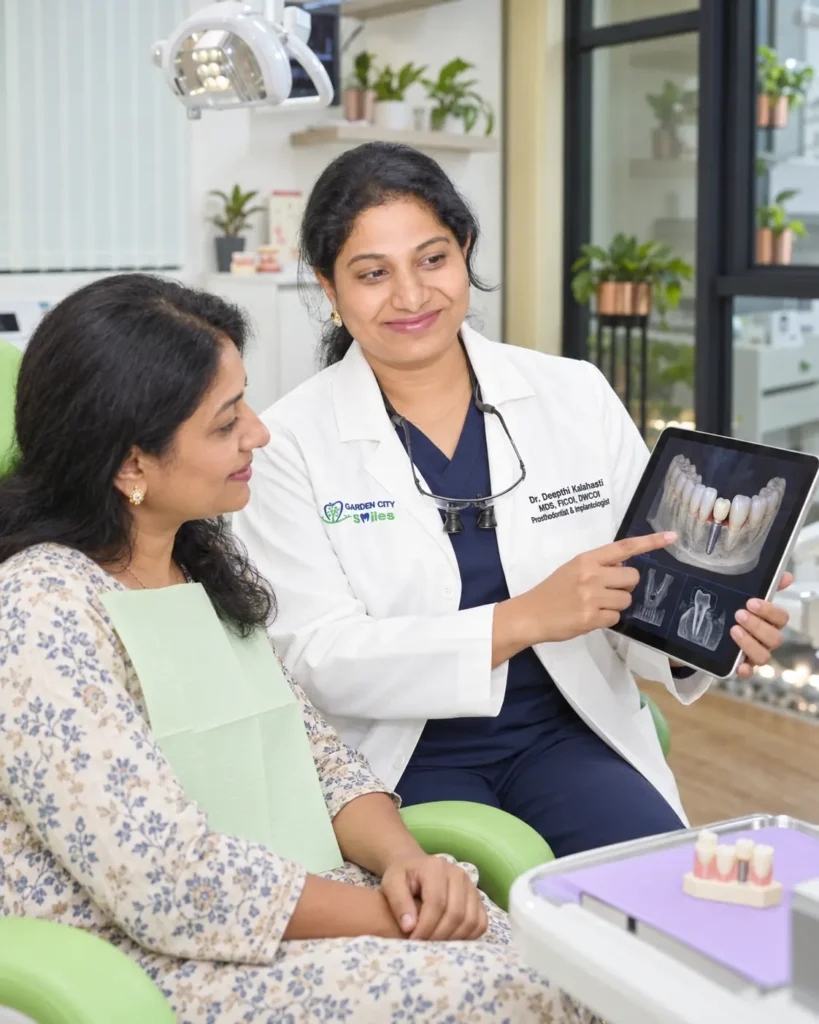
Dr Deepthi Kalahasti
Prosthodontist & Implantologist
What Would You Like Help With?
Choose the situation closest to yours. You do not need to know which treatment you need.
Can Your Tooth Be Saved?
A cracked, loose or repeatedly treated tooth needs a diagnosis before an extraction decision. We assess the remaining tooth, roots, gum and bone support, infection and bite.
Preserve: root canal, crown or gum treatment may be appropriate. Monitor: selected teeth can be reviewed over time. Replace: discuss extraction and replacement when a tooth cannot be predictably restored.
Implant, Bridge or Denture?
The right option depends on your neighbouring teeth, bone, gums, health and preferences. Compare the practical differences before choosing.
| What Matters | Dental Implant | Fixed Bridge | Removable Denture |
|---|---|---|---|
| Support | An implant in the jawbone supports a crown or bridge. | Neighbouring teeth support the replacement. | The gums and/or remaining teeth support it. |
| Neighbouring teeth | Usually avoids preparing neighbouring teeth for support. | Conventional bridges usually need tooth preparation; adhesive designs differ. | Some designs need rests or other preparation on supporting teeth. |
| Surgery | Required; grafting may also be needed. | Usually no implant surgery. | Usually no implant surgery. |
| Time | Often several months; healing and additional procedures affect timing. | Often weeks once the supporting teeth and tissues are ready. | Often weeks; extractions and healing can extend the plan. |
| Cleaning | Daily cleaning around the implant and restoration. | Cleaning beneath the replacement tooth and around supporting teeth. | Remove for cleaning and care for the gums and remaining teeth. |
| Long-term care | Monitor the gum, bone, bite and components. | Monitor the supporting teeth, gums and bridge. | Review fit, supporting tissues and any need for adjustment or relining. |
Choose a topic to compare all three options together.
01Support+
- Dental Implant
- An implant in the jawbone supports a crown or bridge.
- Fixed Bridge
- Neighbouring teeth support the replacement.
- Removable Denture
- The gums and/or remaining teeth support it.
02Neighbouring teeth+
- Dental Implant
- Usually avoids preparing neighbouring teeth for support.
- Fixed Bridge
- Conventional bridges usually need tooth preparation; adhesive designs differ.
- Removable Denture
- Some designs need rests or other preparation on supporting teeth.
03Surgery+
- Dental Implant
- Required; grafting may also be needed.
- Fixed Bridge
- Usually no implant surgery.
- Removable Denture
- Usually no implant surgery.
04Time+
- Dental Implant
- Often several months; healing and additional procedures affect timing.
- Fixed Bridge
- Often weeks once the supporting teeth and tissues are ready.
- Removable Denture
- Often weeks; extractions and healing can extend the plan.
05Cleaning+
- Dental Implant
- Daily cleaning around the implant and restoration.
- Fixed Bridge
- Cleaning beneath the replacement tooth and around supporting teeth.
- Removable Denture
- Remove for cleaning and care for the gums and remaining teeth.
06Long-term care+
- Dental Implant
- Monitor the gum, bone, bite and components.
- Fixed Bridge
- Monitor the supporting teeth, gums and bridge.
- Removable Denture
- Review fit, supporting tissues and any need for adjustment or relining.
Bone changes can still occur after tooth loss and around implants. No option guarantees permanent bone preservation or a lifetime result. We explain the trade-offs for your mouth.
How an Implant Replaces a Tooth
Select a label on the illustration to see what each part does.
Simplified cross-section · Select a label to explore.
Crown
The tooth you see
The crown is the visible replacement tooth, shaped and shaded to fit your smile and bite.
Its position and chewing surface help guide the whole implant plan.
Connector
The connection beneath the crown
The connector, called an abutment, joins the implant to the crown.
Its shape helps the tooth emerge through the gum and allows access for cleaning.
Implant
The support within the jawbone
The implant sits in the jawbone and supports the replacement tooth.
Its position is planned around the final tooth, available bone and nearby structures.
Gum
The soft tissue around the tooth
Healthy gum surrounds the restoration and helps you keep the area clean.
Gum shape influences appearance, comfort and cleaning access.
Jawbone
The foundation for support
The surrounding bone supports the implant and forms a close connection with its surface during healing.
Bone and gum health still need regular examination after treatment.
Explore Your Replacement Options
Simplified illustration · Your plan may differ.
One Missing Tooth
A replacement that stands on its own
One implant can support a crown without using neighbouring teeth as bridge supports. A bridge or removable replacement may also be appropriate.
Consider the health of the neighbouring teeth alongside the implant option.
Simplified illustration · Your plan may differ.
Front Tooth
Plan the appearance as well as the support
The visible result depends on gum shape, tooth colour, smile line and implant position.
Ask about a temporary tooth before treatment so you know what to expect while healing.
Simplified illustration · Your plan may differ.
Several Missing Teeth
Several teeth can share implant support
An implant-supported bridge may replace several missing teeth. The number and position of implants depend on the individual plan.
The bridge must allow comfortable chewing and access for daily cleaning. The illustration shows one example.
Simplified illustration · Your plan may differ.
Loose Dentures
Understand removable and fixed options
Implants can help retain a denture that you remove for cleaning, or support a restoration that remains fixed in place.
These are different treatments with different cleaning needs and bone requirements.
Are Dental Implants Suitable for You?
We assess bone, gum health, bite, oral hygiene, smoking, general health and medicines. Age alone does not decide suitability.
Three-dimensional imaging, where clinically indicated, helps assess available bone and nearby structures. Grafting or an alternative replacement may be discussed; neither is assumed in advance.
Some people need gum treatment, medical coordination or additional healing before surgery. Your findings help us plan the appropriate sequence.
Bring your medication list and relevant dental or medical reports. Do not change prescribed medicines without advice from your treating clinician.
Your Treatment Journey
From your first visit to long-term care. Open a stage for the practical details.
Simplified stage illustration · Clinical approaches vary.
We examine your teeth, gums and bite, review your health and discuss what can be saved. Photographs, scans or 3D imaging are arranged where needed.
Understand the realistic options before choosing treatment.
Simplified stage illustration · Clinical approaches vary.
Gum treatment, extraction or grafting may be needed. For a visible gap, a temporary tooth is planned individually.
Ask what you will wear, eat and look like while healing.
Simplified stage illustration · Clinical approaches vary.
The implant is positioned at the planned site, normally under local anaesthesia. The final tooth and nearby structures guide the surgical plan.
Ask how to plan work, travel and recovery.
Simplified stage illustration · Clinical approaches vary.
The team checks healing and stability before moving to the final restoration. This often takes several months and may take longer after additional procedures.
Follow your individual eating and cleaning instructions.
Simplified stage illustration · Clinical approaches vary.
The fit, appearance, bite and cleaning access are checked before the final crown or bridge is completed.
Learn how to clean around your particular restoration.
Simplified stage illustration · Clinical approaches vary.
Return for the reviews advised for your risk level. The team monitors gum health, bone, bite and components.
Report bleeding, swelling, movement or a change in the bite.
Recovery, Risks and What to Expect
Local anaesthesia is normally used during placement. Tell the dentist if you feel pain during the procedure. Afterwards, swelling, tenderness and time away from work vary with the surgery and your healing.
Follow your individual instructions for cleaning, food, activity and pain relief. Discuss travel and work commitments beforehand.
Risks include infection, failure to integrate with bone, damage to nearby structures, altered sensation and later problems with the gum, bone or restoration. Your treating dentist should explain the risks relevant to your plan before consent.
The dentist assesses the cause and whether removal, healing, another implant or a different replacement is appropriate. Further treatment and timing need a new discussion.
Brush daily, clean between teeth and around the implant using the aids recommended for your restoration, and attend your planned reviews.
Implants cannot develop tooth decay, but surrounding tissues can develop disease. The team monitors gums, bone, bite and prosthetic components.
When to Contact the Clinic
Contact us promptly for worsening pain or swelling, fever, persistent bleeding, unexpected numbness, looseness or a change in your bite.
For difficulty breathing or swallowing, seek urgent hospital care.
Your Implant and Restorative Planning
Dr Deepthi Kalahasti
Prosthodontist & Implantologist
Founder & Director, GardenCity Smiles™ Dental Clinic
Planning considers the final tooth shape, bite, appearance and cleaning access alongside the surgical requirements. Dr Deepthi and the team explain the proposed care and who will carry out each stage.
Also holds American Board Certification in Orofacial Pain.
Questions Before You Decide
Let’s Discuss Your Implant Options
Tell us what is troubling you. We will help you understand the realistic options.
GardenCity Smiles™
No. 803, KHB Colony, Yelahanka New Town, Bengaluru 560064
Mon–Sat: 9:30 AM–7:30 PM · Sunday by appointment
New patients: please arrive 10 minutes before your confirmed appointment to complete registration.
General patient information. An in-person examination is needed to establish your diagnosis and treatment suitability.
To arrange a visit, Call Clinic or message GardenCity Smiles™ on WhatsApp.